We use optional analytics cookies to understand visits and improve our website. You can accept or decline them.

Copper Tripeptide-1 (GHK-Cu)
Cosmetic ingredient sourcing and batch verification
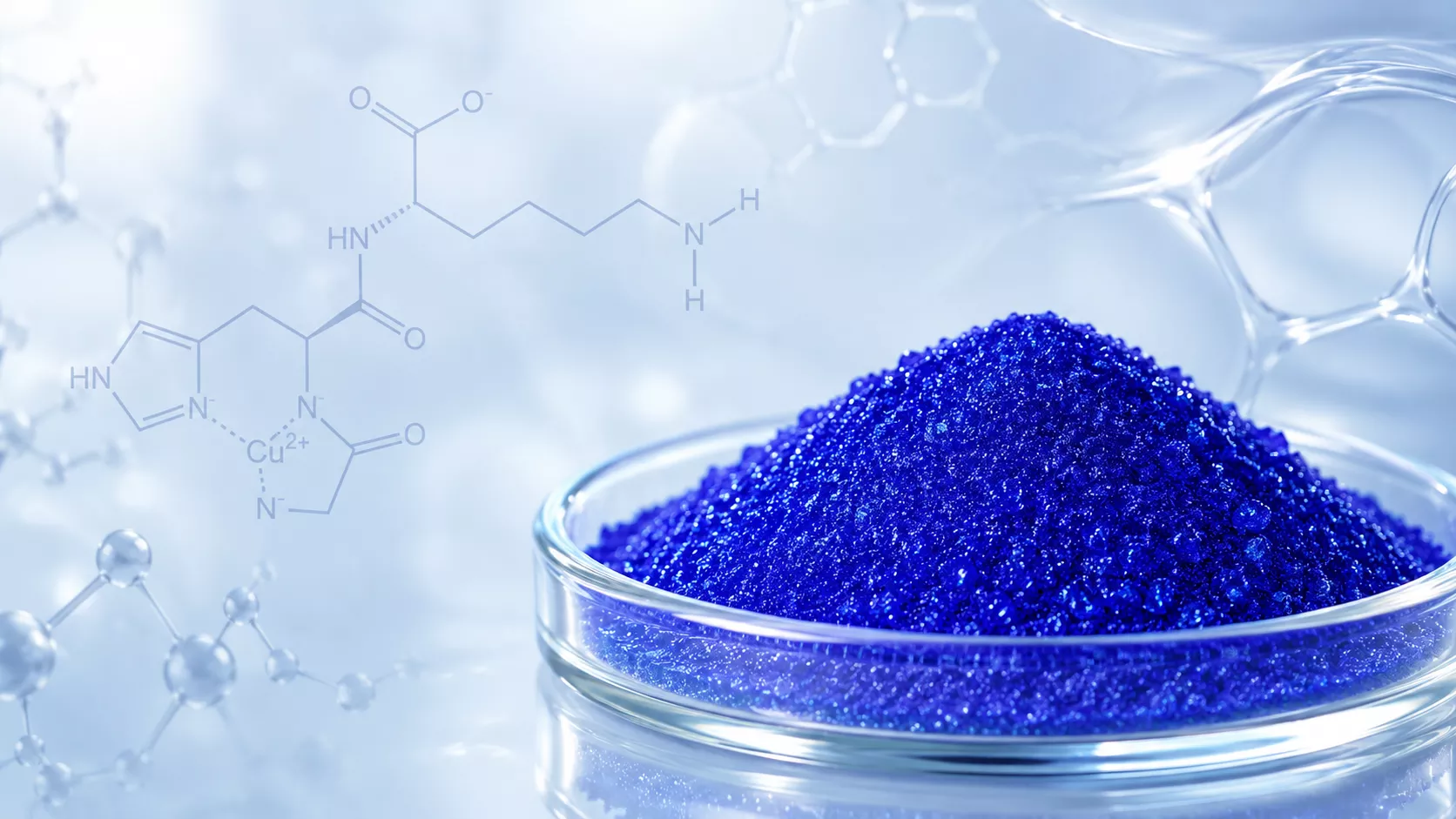
Copper Tripeptide-1 (GHK-Cu) Sourcing and Batch Quality Control
iTra supplies this ingredient through its sourcing network. Every order undergoes batch-to-batch quality checks at our Chongqing laboratory before shipment. Our San Jose office coordinates inquiries, samples, in-person presentations and after-sales support for customers in Europe and the Americas.
TDS, MSDS and COA are available on request for all our ingredients. Sales specifications and lead times are confirmed for each order. Contact us about the applicable quality checks, samples and minimum order quantity.
Product Description
Copper Tripeptide-1 (GHK-Cu) for cosmetic formulation
iTra supplies Copper Tripeptide-1, also known as GHK-Cu or blue copper peptide. It is a glycine-histidine-lysine tripeptide complexed with copper ions. The TDS describes solid-phase peptide synthesis and purification, followed by copper complexation and lyophilization.
Technical specifications
| INCI | Copper Tripeptide-1 |
|---|---|
| CAS | 89030-95-5 |
| Molecular formula | C₁₄H₂₂CuN₆O₄ |
| Molecular weight | 401.91 g/mol |
| Appearance | Blue to blue-purple lyophilized powder |
| Solubility | Easily soluble in water; insoluble in oils and fats |
| Purity (TDS) | ≥99.0% |
| Peptide content | ≥85.0% |
| Copper complexation rate | ≥90.0% |
| Water content | ≤8.0% |
| Copper content | 10.0–16.0% |
| Chloride content | 6.5–8.5% |
| GHK content share | 60.0–80.0% |
| Product pH | 5.0–7.0 (1% aqueous solution; confirm by batch COA) |
Specification limits are based on the supplied iTra TDS. The product pH range of 5.0–7.0 in a 1% aqueous solution has been confirmed for this page and matches the MSDS. Request the batch COA and test methods before confirming supply. Purity, peptide content and GHK content share are separate indicators; ≥99% purity does not mean ≥99% peptide content.
Applications and research background
Evaluate in serums, facial creams, eye creams and masks. Technical documentation discusses research on extracellular matrix remodeling, collagen, elastin and antioxidant activity. The cited work includes cellular and animal studies; it does not establish clinical efficacy for the commercial batch or a finished formulation.
The introduction includes enzyme-inhibition reports and GHK-Cu research references. Request complete reports, concentrations and methods to assess relevance. Research findings are not presented as indications for treating wounds or disease.
Suggested use level and formulation
- TDS suggested use level: 50–1,000 ppm (0.005–0.10%).
- Add in the final stage after the formulation has cooled below 45 °C.
- The TDS recommends formulation pH 4.0–6.0. This formulation advice is separate from the analytical product pH; verify stability in the actual formula.
- Avoid prolonged high-temperature exposure. Evaluate compatibility before combining with strong acids, strong bases, oxidizing agents, high concentrations of vitamin C, EDTA, fruit acids or vitamin A-based ingredients. Copper dissociation may cause discoloration or loss of activity.
Storage and handling
Store at room temperature in a cool, dry place, tightly sealed and protected from light. TDS stated retest period: 24 months. Control dust and use appropriate protection; the MSDS identifies ingestion hazards and skin, eye and respiratory irritation. Request the current confirmed SDS for applicable handling and transport classification.
Documentation, samples and supply
TDS, MSDS, COA and the technical introduction are available on request. TDS reference packaging: 5 kg or 20 kg per drum, with customized options. Commercial specifications, packaging, minimum order quantity and lead times are confirmed for each order.
iTra provides batch-to-batch quality checks for each shipment through its Chongqing laboratory. HPLC, UV-Vis, GC and other characterization are selected according to the ingredient and agreed method. The San Jose office supports customers in Europe and the Americas with samples, in-person presentations and aftersales support.
Frequently asked questions
Are GHK-Cu and Copper Tripeptide-1 the same ingredient?
GHK-Cu is the common name for the copper complex; Copper Tripeptide-1 is the INCI listed in this product documentation.
Can it be added during a hot process?
The TDS advises adding after cooling below 45 °C and avoiding prolonged heating.
Which documents confirm batch quality?
Request the batch COA, TDS and current SDS, and confirm test methods and formulation requirements with iTra.
Batch Verification Example
| Parameter / batch | CP-0006-2606003 | CP-0006-2607004 | CP-006-2608005 |
|---|---|---|---|
| Production date | 2026-06-11 | 2026-07-13 | 2026-08-17 |
| Purity, HPLC (%) | 99.4 | 99.5 | 99.5 |
| Total copper, ICP-OES (%) | 14.1 | 14.3 | 14.1 |
| Peptide assay as GHK-Cu equivalent, as received (%) | 92.6 | 93.3 | 93.4 |
| Water, Karl Fischer (%) | 5.8 | 5.8 | 6.3 |
| Specification / report no. | CP-0006-260011 | CP-0006-260012 | CP-0006-260013 |
Retest results from three different batches illustrate batch-to-batch consistency, not time-course stability of one batch. Peptide assay is quantified by HPLC after demetallation and expressed as GHK-Cu equivalent on an as-received basis. It must not be added to the copper percentage or interpreted as a complexation rate. Request the COA and applicable methods for your supply.
Understanding GHK-Cu Quality
Understand copper in skin, GHK chelation, peptide assay, total copper and water testing, with three-batch iTra laboratory data.
Related Products